Statistically Shakespeare
Shakespeare explored through the eyes of a statistician, new to the world of English Literature, and naturally leading to singular results
CONTACT ME
Available for advisory sessions, project discussions, & speaking engagements
This site’s goal is to present information on Shakespeare that is grounded in scientific and quantitative methods from a career statistician and scientific researcher whose deep interest in Shakespeare only began during COVID confinement. Upon recognizing a great absence of analytic study regarding the author, interest in the subject quickly developed from a hobby into a personal quest; one seeking an answer to:
the Shakespeare Authorship Question
This site endeavors to fill the gap of research and data on the topic of the author of the Shakespeare canon. Scientific methods are applied to confirm or disprove previous unsubstantiated claims about the author. Use this site to arm yourself with unbiased, concrete evidence that challenges widely “accepted” answers; begin to look at familiar text through a new lens and return here to look for more statistical methodologies for challenging traditional Shakespearean maxims.
About Kimberly R. Barber, Phd.
Kimberly has a PhD in Sociology with a minor in Statistics and a MSci degree in Epidemiology. She has publications in medicine, medical education and in healthcare research. She was a Professor of Healthcare Education, Health Professions, Public Health and Statistical Concepts & Applications. She has presented her research findings throughout Europe and North America, chaired the Institutional Ethics Review Board, served as a reviewer for multiple medical journals

Untangling the Most Famous Literary Name in History
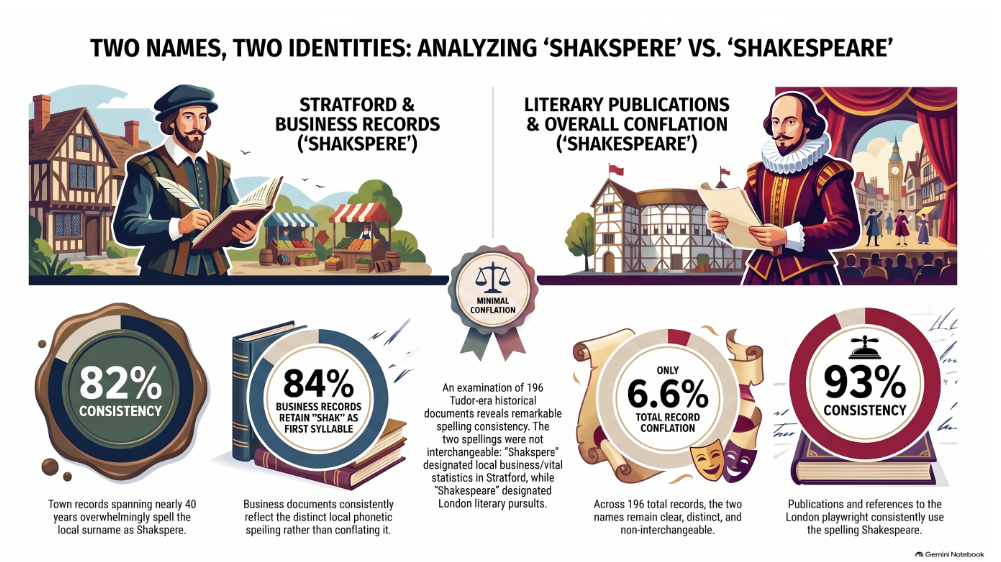
An analysis of historical documentation demonstrates that “Shakspere” and “Shakespeare” functioned as distinctly separate surnames rather than interchangeable variants. Local vital statistics and commercial documents from Stratford predominantly utilized the Shakspere spelling for the hometown resident, whereas publishing materials overwhelmingly favored Shakespeare for the London-based dramatist. When accounting for minor clerical mistakes and typographical errors, the actual rate of conflation between the two distinct names remains exceptionally low at just over six percent. Ultimately, the evidence indicates that the Stratford businessman and the literary playwright maintained separate identities reflected by their respective name spellings.